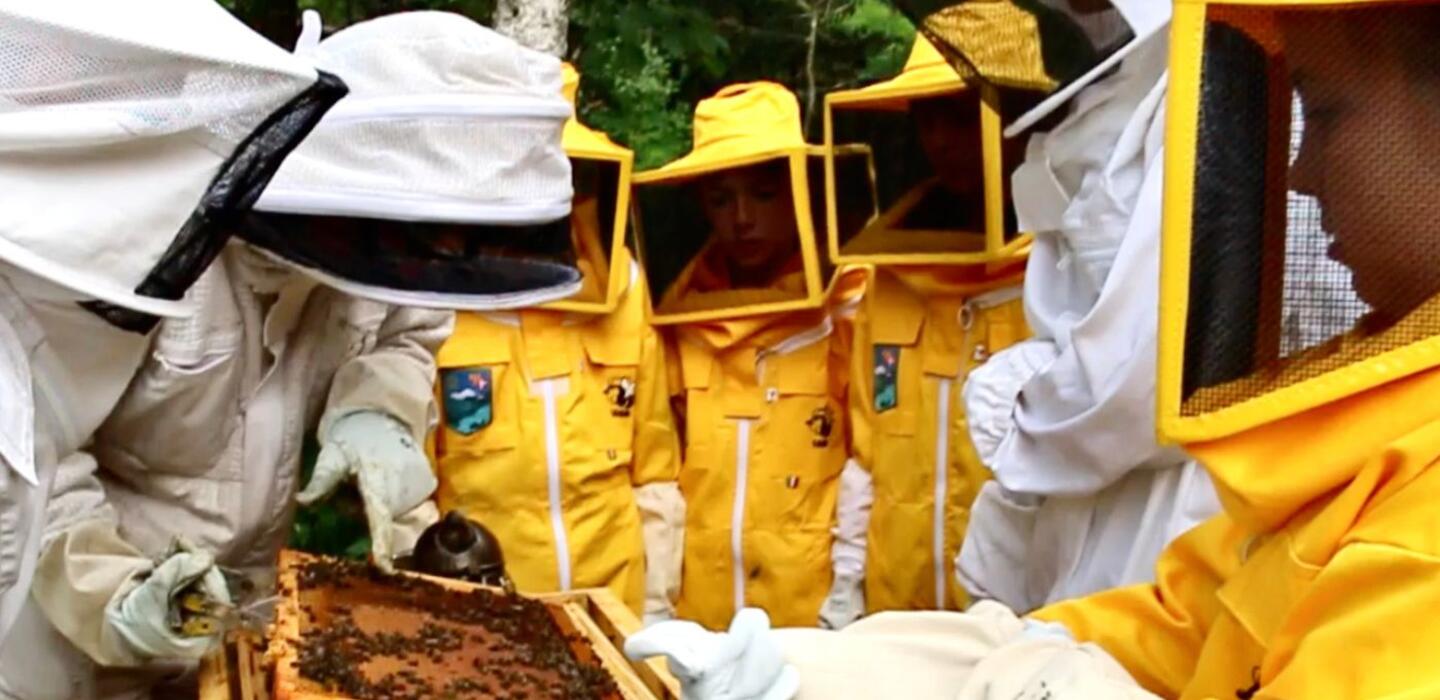
Bees are crucial keystone species for global biodiversity, pollinating over 75% of food crops and nearly 90% of wild flowering plants, which support ecosystem health and food webs. According to the Food and Agriculture Organization (FAO) of the United Nations, a third of the world’s food production depends on bees. Unfortunately, the population of bees and other pollinators has been declining globally over recent decades due to habitat loss, intensive farming practices, changes in weather patterns and the excessive use of pesticides and other agrochemicals. This poses a threat to a variety of plants critical to human lives.
When the students took the honey frames and put them into the centrifuge, they saw firsthand the yellow gold honey flowing into the jars and that was a magical experience for the teenagers.
L'Abeille du Môle is an association in Marignier, France, that spreads awareness about bees and their importance to biodiversity. Through education and hands-on experiences, the association is working to help young people understand the vital role pollinators play in sustaining life on Earth.
To support this effort, the Lions of Faucigny provided a US$2,216 District and Club Community Impact Grant (DCG) from Lions Clubs International Foundation. The grant helped fund an educational beehive, protective suits for children and teenagers and communication materials that allow the association to bring biodiversity education directly into schools.
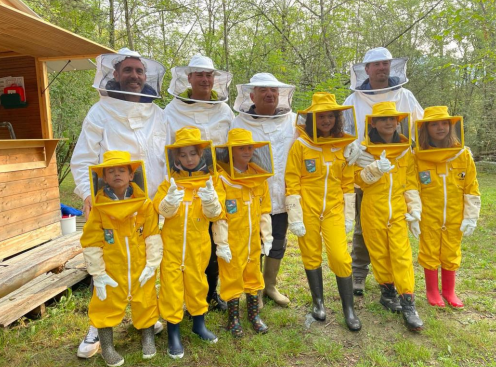
President of Faucigny Lions Club, Bertrand Duby explains how this has become an urgent need in their community. “Our valley is evolving very quickly, and we are seeing fruit meadows disappearing and the habitat of pollinators becoming restricted,” he says. “Raising awareness among children, who, by making the bee their own, quickly understand the need to replant the types of trees that bees rely on to produce honey, which allows us to create a link with parents.” This domino effect between child to parent is very effective and powerful. “A convinced child means at least three to four adults become aware of the issue, possibly leading to one tree planted,” Duby explains.
“A child’s first visit to the apiary is very memorable. At the beginning, some children seem stressed while others are very excited. The opening of the hive with rather gentle colonies helps children discover the bee. In five minutes, the children are smoking the hive, lifting the frames, and the most fearful are gaining confidence by catching the bees in clusters with their gloves.” Duby says. “Dressing up in overalls and gloves allows them to leave school and enter the beekeeping world.”
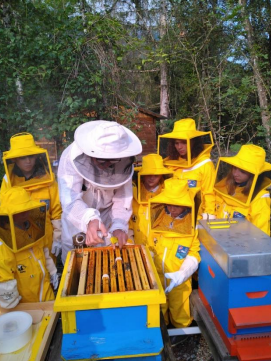
Working with teenagers was also challenging at first, but in a different way. “In the beginning, teenagers seem to take a wait-and-see approach with the discovery of the beekeeping world. However, tasting honey and constructing the chimney hive brought concreteness, motivation and created a team spirit,” Duby explains.
One of Duby’s favorite moments was when the teenagers suited up and transferred a swarm into their hives in front of facilitators, Lion members and municipal officials. Yet for many students, the highlight came later. “When the students took the honey frames and put them into the centrifuge, they saw firsthand the yellow gold honey flowing into the jars and that was a magical experience for the teenagers,” Duby says. At the end of the program, everyone left with their pot of honey and a deeper understanding of biodiversity and the natural world.
Learn how your community can use an LCIF District and Club Community Impact Grant (DCG) to help heal our planet.
Shelby Washington is the content specialist at Lions Clubs International Foundation.